Law firm website statistics tell the story over and over again: Attorney bio pages grab the lion’s share of the site’s traffic. Clients, potential clients and referral sources want to know about you, your expertise and your experience. Why not reward them with an engaging and insightful picture of what you can do? It’s always hardest to do it for yourself (which is why many firms turn to us), but we think breaking it down into four steps makes it doable in about an hour.
Take the bio challenge.
First review the first paragraph. This is your "grabber". If you can't grab the attention of the reader by answering the "what's in it for me" for question. You are wasting your time. Don't bury the lead. Put your best foot forward.
Keep your bio updated! Don't forget to put your latest and greatest on your bio page. Commit to updating your site at least once a month.
Put your best face forward! Make sure your bio picture reflects your best self. If you haven't updated your photo in a couple years- its time.
Showing posts with label Lawyer Marketing. Show all posts
Showing posts with label Lawyer Marketing. Show all posts
Monday, March 30, 2015


Monday, September 29, 2014
Ten Point Plan for Healthy Marketing
A legal news aggregation website called LawFuel.com recently
ran a post with a 10-point checklist of how law firms can gauge the
health (and effectiveness) of their legal marketing programs.
Here’s the list -- how are you performing?
1. Does your firm encourage cross-selling among
attorneys? If you have multiple practice areas and lawyers who
specialize in each area, then those lawyers should be cross-selling your
services. Make sure all your attorneys understand your total
offerings.
2. Is your staff involved in marketing? Your
legal marketing efforts should touch every member of your staff, who are
your ambassadors to pass along your expertise to their contacts.
3. Do you have a program for keeping in touch
with former clients? This is a no-brainer. Add them all to your
monthly e-newsletter list and establish a system for sending out
keep-in-touch emails that doesn’t require any babysitting from busy
lawyers.
4. Are all your lawyers engaged in business
development? If not, implement a training program on your marketing
messaging and encourage them to get out and network.
5. Is your website current? An out-of-date website tells prospects that your firm is out of date.
6. Is anyone managing your online reputation?
Reputation management is critical for law firms.
You should have this
task assigned to someone (internal or external) who regularly conducts
online searches for your firm name and attorney names. If something bad
pops up, you should have a process for dealing with it effectively.
7. Are all your attorney bios up to date online?
Every attorney should have a complete and current bio with a
professional photos on LinkedIn, Avvo, Martindale, etc.
8. Do you have a blog? A blog is one of the best
ways for you to market to your niche, highlighting your practice areas
and pumping out fresh content that showcases your expertise in each.
9. Are you providing added value to clients?
Providing clients with value above and beyond what they are paying for
will keep them coming back.
10. Are you micro-managing the client experience?
Do clients have to wait when they show up for an appointment? Are you
offering them something to drink and making them feel at home? If not,
you need to take another look at how your firm treats clients because
they are measuring you not just against other law firms but against
every service provider they know. And if they don’t like the fit, they
won’t be back.
© The Rainmaker Institute, All Rights Reserved
Monday, June 30, 2014
7 News Trends And How They Affect PR
If your job is to communicate with journalists, your duties are
becoming more complicated because of these disturbing news media trends:
Trend No. 1: Media speculation
CNN has taken the sin of speculation to an all-time high with its 24/7 guessing game regarding the disappearance of Malaysia Flight 370.
In the future, you will spend more time than ever before responding to rumors. Combat this with more frequent crisis communications directly to your audiences.
Trend No. 2: Breaking news is broken, and there is nothing breaking
The phrase "breaking news" previously described events that were "breaking" at that very moment, such as a fire or explosion. Sadly, today news stations slap the moniker on whatever the first story of the newscast is, even if the event happened hours before.
This makes your job harder, because your little crisis might get portrayed as a much bigger crisis. You can't afford to linger in your response and allow the media to blow things out of proportion.
Trend No. 3: Exclusive
Excessive use of the term "exclusive." In its purest form, an exclusive is an interview all media outlets wanted but only one could get, revealing groundbreaking information.
Tread with caution that the one-on-one interview you give doesn't get portrayed as something bigger than it really is.
Trend No. 4: Trending now
Social media trends are taking precedent over real news. The "Today" show and "Good Morning America" feature special rooms where they focus on what's trending. Local stations are wasting valuable airtime repeating fluff on social media.
When you pitch a news event in the future, you must make it more visual and trend-able.
Trend No. 5: Caught on camera
An increasing number of events are getting news coverage simply because they were captured on video. These days, if a tree falls in the woods and it's not on video, it is not news. But if someone gets video, it could get airtime.
If someone captures compromising video of your executives, employees, or a mishap, you must be ready to respond with the speed of social media and not the slow pace of traditional corporate communications.
Trend No. 6: Social media backlash
News stations increasingly are reporting what people think and feel about various topics on social media. This makes your company face tougher scrutiny than ever, with potential damage to your reputation and revenue.
The time is now to rethink your social media and crisis communication strategies.
Trend No. 7: Unconfirmed reports
The phrase "has not confirmed" has been used over and over in recent broadcasts, specifically 187 times on "Morning Express with Robin Meade" (source: IQ Media). These news releases are unverified rumors, repeated from source to source.
This means you need a skilled staff or vendor who can monitor online content every minute of the day and well-trained spokespeople to fully address your scenarios.
Gerard Braud heads Braud Communications.
Trend No. 1: Media speculation
CNN has taken the sin of speculation to an all-time high with its 24/7 guessing game regarding the disappearance of Malaysia Flight 370.
In the future, you will spend more time than ever before responding to rumors. Combat this with more frequent crisis communications directly to your audiences.
Trend No. 2: Breaking news is broken, and there is nothing breaking
The phrase "breaking news" previously described events that were "breaking" at that very moment, such as a fire or explosion. Sadly, today news stations slap the moniker on whatever the first story of the newscast is, even if the event happened hours before.
This makes your job harder, because your little crisis might get portrayed as a much bigger crisis. You can't afford to linger in your response and allow the media to blow things out of proportion.
Trend No. 3: Exclusive
Excessive use of the term "exclusive." In its purest form, an exclusive is an interview all media outlets wanted but only one could get, revealing groundbreaking information.
Tread with caution that the one-on-one interview you give doesn't get portrayed as something bigger than it really is.
Trend No. 4: Trending now
Social media trends are taking precedent over real news. The "Today" show and "Good Morning America" feature special rooms where they focus on what's trending. Local stations are wasting valuable airtime repeating fluff on social media.
When you pitch a news event in the future, you must make it more visual and trend-able.
Trend No. 5: Caught on camera
An increasing number of events are getting news coverage simply because they were captured on video. These days, if a tree falls in the woods and it's not on video, it is not news. But if someone gets video, it could get airtime.
If someone captures compromising video of your executives, employees, or a mishap, you must be ready to respond with the speed of social media and not the slow pace of traditional corporate communications.
Trend No. 6: Social media backlash
News stations increasingly are reporting what people think and feel about various topics on social media. This makes your company face tougher scrutiny than ever, with potential damage to your reputation and revenue.
The time is now to rethink your social media and crisis communication strategies.
Trend No. 7: Unconfirmed reports
The phrase "has not confirmed" has been used over and over in recent broadcasts, specifically 187 times on "Morning Express with Robin Meade" (source: IQ Media). These news releases are unverified rumors, repeated from source to source.
This means you need a skilled staff or vendor who can monitor online content every minute of the day and well-trained spokespeople to fully address your scenarios.
Gerard Braud heads Braud Communications.
Wednesday, June 25, 2014
Top Ten Topics on Twitter and Facebook
The 10 most popular content topics on Facebook and Twitter are similar,
but once you leave the top 10, topics differ significantly, a recent Klout study says.
The report was based on Klout Topics data from more than 580 million people around the world.
The analysis found that music and television rank as the No. 1 and No. 2 most popular topics, respectively, on both Facebook and Twitter. Content concerning celebrities, software, holidays, films and business is also extremely popular on both social networks.

Overall, 40 percent of topic interactions on Facebook and Twitter occur around the top 10 content areas. Engagement patterns look similar for each network.
However, the remaining 60 percent of engagement comes from topics beyond the top 10. The percentage of interactions with those subjects differs significantly by network.

Among the most noticeable variances between Facebook and Twitter are:
The report was based on Klout Topics data from more than 580 million people around the world.
The analysis found that music and television rank as the No. 1 and No. 2 most popular topics, respectively, on both Facebook and Twitter. Content concerning celebrities, software, holidays, films and business is also extremely popular on both social networks.
Overall, 40 percent of topic interactions on Facebook and Twitter occur around the top 10 content areas. Engagement patterns look similar for each network.
However, the remaining 60 percent of engagement comes from topics beyond the top 10. The percentage of interactions with those subjects differs significantly by network.
Among the most noticeable variances between Facebook and Twitter are:
- Restaurants
- Facebook: 76th most popular topic
- Twitter: 112th most popular topic
- Variance: 36 spots
- Homework
- Facebook: 196th most popular topic
- Twitter: 98th most popular topic
- Variance: 98 spots
- Dogs
- Facebook: 23rd most popular topic
- Twitter: 95th most popular topic
- Variance: 72 spots
- Cats
- Facebook: 52nd most popular topic
- Twitter: 104th most popular topic
- Variance: 52 spots
- Babies
- Facebook: 21st most popular topic
- Twitter: 66th most popular topic
- Variance 45 spots
- Parenting
- Facebook: 22nd most popular topic
- Twitter: 50th most popular topic
- Variance: 28 spots
- Customer service
- Facebook: 197th most popular topic
- Twitter: 89th most popular topic
- Variance: 108 spots
Sunday, June 8, 2014
Measuring Your Social Media Efforts

There's a popular misconception that
it's difficult to use targeted metrics to measure social media's return
on investment (ROI). That's not true. Nor is
social media only good for measuring brand awareness.
The fact is social media can offer some of the best metrics for
measuring ROI. All you need to do is set your success guides—what you
want to achieve and
how long it will take—and measure your results against them.
Here are six simple metrics for the main social networks that you can use to measure your social media ROI across earned, owned and paid media:
1. Blogger outreach
A key component of many (if not most) social media campaigns, blogger outreach programs can offer some of the best results of any marketing tactic. Measuring your success isn't too difficult, either. All you have to do is determine the answers to the following questions:
Twitter not only offers instant eyeballs, but great returns. Again, measuring your impact is relatively simple:
Although it has its critics (including me), Facebook offers some great built-in tools and demographic options to help gauge a campaign's success:
While we don't quite know the effectiveness of brand pages on Google+ and in-line Google Ads complement Google+ content, there are ways to measure your activity:
More than just a fun place to see kids hurt themselves on bikes, YouTube is a key tool in any marketing campaign—just ask the companies that used it during this year's Super Bowl.
Here are the questions you should ask:
As marketing evolves, the different ways to reach an audience combine to create new outlets. Mobile marketing is the perfect complement to social marketing, and is easy to measure:
No matter how you collect the information you need, it all comes down to comparing man hours and financial outlay to your return.
It's important to remember that marketing can come down to luck and circumstance as much as brilliant strategy-timing and a welcoming audience are key. The one thing you can control, however, is measurement, and with social media and mobile marketing, measurement has never been easier.
A version of this article originally appeared on DannyBrown.me.
Here are six simple metrics for the main social networks that you can use to measure your social media ROI across earned, owned and paid media:
1. Blogger outreach
A key component of many (if not most) social media campaigns, blogger outreach programs can offer some of the best results of any marketing tactic. Measuring your success isn't too difficult, either. All you have to do is determine the answers to the following questions:
- How many bloggers wrote about you?
- How many comments did these posts receive?
- How many social shares did the post get?
- What was your traffic pre- and post-outreach?
- How much product did you have to provide to bloggers, and how many sales did you receive?
Twitter not only offers instant eyeballs, but great returns. Again, measuring your impact is relatively simple:
- What was your retweet value (cost of manpower and resources versus followers who take action)?
- How often did people use your hashtag?
- How many times did people click your vanity URL?
- How many new (genuine) followers did you get during your promotion?
- If you used something like sponsored tweets, what was the cost versus the click-throughs and conversions?
Although it has its critics (including me), Facebook offers some great built-in tools and demographic options to help gauge a campaign's success:
- How many new, worthwhile fans did you make, and how many did you target?
- How many times did people like or act on your promotion message?
- If you built a Facebook application, how many times did people install or share it?
- Did you successfully reach your target demographic? (Facebook Insights can help.)
- How much did you spend on a Facebook ad, and how did click-throughs and new sales/customers compare?
While we don't quite know the effectiveness of brand pages on Google+ and in-line Google Ads complement Google+ content, there are ways to measure your activity:
- Has Google+ raised your profile on search, as well as resulting traffic to your site?
- How many circles have people added you to?
- How many +1s do your comments and discussions receive?
- How active is your community?
- How many ripples do your discussions create?
- How many attendees take part in your hangouts?
More than just a fun place to see kids hurt themselves on bikes, YouTube is a key tool in any marketing campaign—just ask the companies that used it during this year's Super Bowl.
Here are the questions you should ask:
- How many views did you get?
- How many likes and favorites did you receive?
- How many downloads did you get (on video sites that allow downloads)?
- How many embeds has your video seen elsewhere on the Web?
- How many subscribers did your channel attract?
- If your video had a call to action with a vanity URL, how many times did people click through?
- How many social shares did you get on the social networks your target demographics use?
As marketing evolves, the different ways to reach an audience combine to create new outlets. Mobile marketing is the perfect complement to social marketing, and is easy to measure:
- Did you use a push SMS system to drive traffic to a mobile-friendly site? If so, how many views did it bring?
- Did you use QR codes? If so, how many times did people use them?
- How many downloads did your mobile app receive?
- How many times did people check-in on Gowalla and Foursquare?
- What was the most popular operating system? (This can tell you a lot about your audience's demographic and buying options.)
No matter how you collect the information you need, it all comes down to comparing man hours and financial outlay to your return.
It's important to remember that marketing can come down to luck and circumstance as much as brilliant strategy-timing and a welcoming audience are key. The one thing you can control, however, is measurement, and with social media and mobile marketing, measurement has never been easier.
A version of this article originally appeared on DannyBrown.me.
Wednesday, May 14, 2014
What Your Corporate Clients Want to Hear
As published in the May 2014 issue of Marketing The Law Firm. No time to read? Click here to watch the video.
To be successful in generating new business and attracting new clients, it's essential to speak the language of your target clients. Furthermore, lawyers should actually use the words that clients want to hear.
The magic is to observe examples of
efficiency, predictability and cost effectiveness already taking place.
Once you have found them, cast a spell by saying Expelliarmus and
articulate these benefits into a unique selling proposition.
To be successful in generating new business and attracting new clients, it's essential to speak the language of your target clients. Furthermore, lawyers should actually use the words that clients want to hear.
It's true that there are
“magic words” you should use in your marketing and business development
initiatives. Like speaking the language of a native in a foreign land,
your message will suddenly resonate with the people you're trying to
reach. No translation will be necessary. You'll have cut through the
clutter.
You can tell when the magic words are missing. As the following law firm slogans show, the enchantment is not there.
- Building Solutions.
- Aligned for Excellence.
- Our Independence Makes the Difference.
These statements don't
even mean anything. These actual law firm taglines are pedestrian
collections of words picked out of a management consultant's thesaurus.
These were apparently written by a committee that wanted to go home.
Isn't there a law firm that has a better command of words? How about:
- Not just any law firm.
- Lawyers you'll swear by. Not at.
- Law, less ordinary.
Now we can tell that
the law firm hired an advertising agency with people who were smoking
pot or taking Adderall. Maybe both. They're clever, but like Seinfeld,
they're about nothing. There is still no magic. What about these
- Knowing your business and understanding your industry.
- Our Mission is Your Success.
- Your Future is Our Business.
Feel free to check out “124 Catchy Law Firm Slogans and Attorney Taglines” at http://bit.ly/1hkS4jK.
You will feel like Sisyphus, the ancient King who was punished by being
compelled forever to roll an immense boulder up a hill, only to watch
it roll back down. I weep for all the wordsmiths who bled across their
keyboards trying to find the password to enter the minds of potential
clients.
Hey, what about “value”
Yes, we all know that
clients want “value.” We have been clubbed senseless by the Association
of Corporate Counsel that this is what in-house counsel crave, like the
flowers need the rain, like a vampire needs blood.
But we all know they're
really talking about discounts and low-price legal fees. As much as they
try to dress it up and put lipstick on a pig, it's all about the money.
Corporations have budgets and law firms are forbidden to exceed them.
Every client loves a bargain. But a law practice can't market itself as
the cheapest firm in town. Promoting your business as the budget option
starts a quick race to the bottom.
There's got to be a better
way. It must be possible to articulate a unique selling proposition that
matches what clients want to hear. The truth is that there are magic
words – three of them in fact – that telegraph the good deal that
clients want without giving away the store.
I first learned about them in the previous century when I was officially on staff in law firm marketing in Chicago. I
would attend marketing conferences where the general counsel panel was
the highlight. The in-house lawyers would whine to the audience about
having to fire lawyers who were arrogant, who charged for photocopies
and who failed to return calls. But learning how not to be the worst
didn't advance my quest for the magic words.
Research became my friend. I
studied the findings based on those secret telephone interviews with
corporate counsel. I downloaded PDFs of studies by consultants who
seemed smarter than me, searching for the glimmer of insight that would
show me what to say. In the withering blizzard of information one report
stood out.
Eureka!
I found what I was looking
for in the 2014 Report on the State of the Legal Market by the
Georgetown Law Center for the Study of the Legal Profession and Thomson
Reuters Peer Monitor. See http://tmsnrt.rs/1kSyYqt. It's 17 pages of deep thought. But you don't need to read it because I'll give it to you in three words.
- Efficiency
- Predictability
- Cost effectiveness
Trust me, if you use any
other words, it will just sound like static to a client. My advice is to
use these words on your website, Facebook page and LinkedIn firm page.
Put it in all your RFP proposals and print it on lawyer business cards.
Use it in all your speeches and webinars. Create a QR code that links to
these exact words.
Notice that the words omit
any reference to law schools, firm history, practices areas or office
locations. That's because clients are not hooked by these things. Those
are “features” of law firms. But efficiency, predictability and cost
effectiveness speak volumes about what clients want to hear. They want
to be told about “benefits.”
The three magic words
convey that you offer a good deal without saying it in so many words.
They spell out the bottom line value in the very terms clients use
themselves.
So if those are the magic
words, how do you support it in your marketing message? I interviewed
the litigators of a business law firm and here is how they articulated
it:
Efficiency: accomplishing a job with a minimum expenditure of time and effort.
- “We save the client money.”
- “Our services is as good as big firms and we're 1/3 of the price.”
- “We staff cases lean instead of having 6-8 lawyers on a case.”
- “We have years of experience to get to the heart of a matter.”
- “Knowing what the client wants creates an efficient relationship.”
Predictability: knowing in advance what to expect – no surprises.
- “We are up front about costs. Clients don't get caught off guard.”
- “Our clients know how a case will play out.”
- “We know litigation well and tell clients what's coming up next.”
Cost effectiveness: providing a good result in relation to cost.
- “We keep an eye on bills.”
- “We don't have fancy office trappings or a fleet of associates to run up bills.”
- “We have a lot of experience and don't have to do a bucket of research.”
Finding the magic in your firm
In my opinion, it is not necessary for a law firm to tear itself down and re-build itself around these
three benefits. That would be great, but no one is going to live that
long. Besides, if you search thoroughly, you'll find that there are ways
the firm is already providing these benefits. There is no need to call
in Harry Potter.
Perhaps your firm starts a
matter by explored the shortest path to a result, whether it's early
settlement or mediation. That's efficient. Perhaps your firm has a
staffing model to include part-time or contract lawyers and outsourcing
for non-legal functions. That's being cost-effective. Perhaps your firm
holds regular, in-person status updates where clients are briefed about a
matter and interviewed about their business. That's predictability.
Begin by visiting the
“About Us” page on your website, highlighting everything, and pressing
“delete.” I guarantee that your clients and prospects will suddenly
start to hear you when you use the magic words.
Wednesday, February 5, 2014
Georgia Attorney Takes Lawyer Advertising to a Whole New Level
A Georgia personal injury attorney, James Casino, has managed to make take his latest commercial viral by creating what must be the most insane lawyer ad ever. The production value is big screen worthy but what really comes through is Casino's personal message about his brother's death. The spot aired during halftime at the Superbowl on the local FOX affiliate WTGS.
The commercial that had been viewed nearly 2.5 million times Tuesday afternoon has stunning production value for a local ad. Although not seen by most of the country, it has become an online smash in the last 24 hours due to its sheer lunacy.
Broadcast locally, it shows the crusading lawyer taking a sledgehammer-sized swipe at his local Savannah Police Department. Casino said the sledgehammer is a staple of his many commercials. And in the ad he uses a fiery sledgehammer to make people aware that cops had allegedly "deceived" the public about the circumstances surrounding his brother's death. He uses his weapon to swipe a tombstone that contained fictional newspaper reports of Lovett's false accusations, he said.
"Speak up for those who cannot speak for themselves, ensure justice for those being crushed," reads a Bible passage that flashes up at the start.
"I'm a very religious person," Casino said. "This was literally Jesus throwing a hammer and saying no way this will happen."
Casino then tells his audience how he used to be a criminal defense attorney "employed by some of the most cold-hearted villains."
Friday, November 22, 2013
80% of Largest 100 Law Firms are Bloggin- Should Yours Be?
Large law firms who aren’t blogging are conspicuous by their absence. This per law firm marketing strategist, Adrian Dayton (@adriandayton).
Rather than blogging declining with the growth of over social media, blogging is growing faster than ever among the Am Law 100.

Why the popularity of blogs among large law firms? Per Dayton:

It’s only a matter of time before all of the top 100 firms use blogs. I’d be surprised if there’s more than couple firms not blogging by the end of next year.
Blogs have proven to be a natural for large law. Blogs enable law firms to share their intellectual capital for business development. Large law has that intellect by virtue of the lawyers the firms attract from leading law schools and judicial clerkships.
Blogs also feel like a natural extension of traditional business development for lawyers in large law who have developed business through writing and speaking.
I can remember almost 10 years ago LexBlog working with its first large law firms. Much has changed. The wild thing is that we are just scratching the surface in blogging among the top 100 law firms.
For more information on blogging among large law firms, please LexBlog’s State of the Am Law 200 Blogosphere.
Rather than blogging declining with the growth of over social media, blogging is growing faster than ever among the Am Law 100.

Why the popularity of blogs among large law firms? Per Dayton:
- Blog posts are the fuel that feeds the social media engine. It is law firms’ blog posts that are shared widely across other social media.
- There is no more powerful tool for search engine optimization (SEO) than the continuous creation of blog content. When clients and prospective clients search online as to an issue that your lawyers could address, is your my firm coming up in the Google search? If the answer is no, it may be time to start blogging.
- Blogs generate high quality work for large law firms. Dayton recently spoke to a firm which has brought in more than 20 high quality engagements through its blogs.

It’s only a matter of time before all of the top 100 firms use blogs. I’d be surprised if there’s more than couple firms not blogging by the end of next year.
Blogs have proven to be a natural for large law. Blogs enable law firms to share their intellectual capital for business development. Large law has that intellect by virtue of the lawyers the firms attract from leading law schools and judicial clerkships.
Blogs also feel like a natural extension of traditional business development for lawyers in large law who have developed business through writing and speaking.
I can remember almost 10 years ago LexBlog working with its first large law firms. Much has changed. The wild thing is that we are just scratching the surface in blogging among the top 100 law firms.
For more information on blogging among large law firms, please LexBlog’s State of the Am Law 200 Blogosphere.
Wednesday, October 30, 2013
Keeping a Law Firm Social Media Policy Simple

Is it possible for a law firm to adopt a five word social media policy?
Microsoft’s social media policy in 2005 was exactly that.
“Be smart.” Or, if that isn’t clear enough, “Don’t be stupid.”That from from Microsoft employee and tech evangelist, Robert Scoble (@scobleizer) in the bible on blogging, Naked Conversations: How Blogs are Changing the Way Businesses Talk with Customers, co-authored by Shel Israel (@shelisrael) and Robert.
A recent post by Ryan Pierson (@FrugalGeek) on employee social guidelines cited the Microsoft policy as an example of keeping social media simple.
I am in total agreement with Pierson that before defining guidelines, which are apt to feel restrictive by employees, identify the benefits of social media. After all, your employees are your law firm’s biggest asset in building the firm’s brand. You ought to be seeking the best way to empower them to build relationships and reputations through social media, not chill their activity.
As one large D.C. based law firm told me this summer, rather than focusing on a policy, they are looking at a social media education program for their lawyers and other professionals. The education will cover the benefits of social media for business development and best practices — to realize the full benefits of social media while reducing risks. Their goal is to get the firm’s lawyers building relationships and reputations via social.
Lawyers have a license they don’t want to put at risk. Firms of any size have policies in place governing various practices, including public relations. The two together along with social media training may accomplish more than any social media policy.
That and “Be smart. Don’t be stupid.”
Sunday, October 27, 2013
Why Google Alerts is the Most Effective Free Marketing Tool

Today we’re talking search tips to improve the accuracy of your Alerts, then I’m sharing super-sleuth strategies to maximize your Alerts and take your marketing strategy to a whole new level.
It’s easy to get started on Google Alerts; all you need is an email address. Go to www.google.com/alerts. You’ll see five boxes: Search Query (what you’re looking for), Result Type (“Everything” is a great place to start), How Often (“Once a day” is fine), How Many (start with “All results”), and Deliver To (your email address.) You can set up to 1,000 Alerts, so it’s basically limitless.
OK, now that you’ve learned how to search, let’s talk about what to search:
1. Set up Alerts on you, your team and your business.
You’ll want Alerts for yourself, key team members, business name, domain name, and top employees. Why? To fully monitor what people are saying about you, your employees, and your business.
Bonus tip: Set up Alerts on the names of your top partners and customers—and send them congratulatory messages when they make the news.
2. Set up Alerts on keywords relevant to your industry.
A great way to stay on top of the trends in your industry. Also, set up Alerts on keywords relevant to your clients and prospects. You’ll better understand their marketplace and their needs.
Bonus tip: Change your Result Type from “Everything” to “Discussion” to find forums where your topic is being discussed. It’s a great way to assess the market and even join the conversation.
3. Set up Alerts on your top clients.
Not only their name, but also topics that might interest them. When you find an article that’s perfect for your top customers, email them a link or, better yet, print it out and send with a personalized card. It’s a great way to demonstrate expertise and personal attention.
4. Set up Alerts on your dream clients and influential people in your industry.
Stay up to date about their activities, so you’re perfectly prepped when you’re ready to pitch them. It’s also a great opportunity to reach out with personal emails and cards. (See No. 3.)
5. Set up Alerts on your competition.
Not only their name, but also domain name, and names of their top team members. Do exactly as we discussed in No. 1, but for your top competitors instead. Pay attention to what their customers are saying; observe how you can serve them better.
Bonus tip: Change your “Result Type” from “Everything” to “Discussions” or even “Blogs” to really discover what their customers are saying and maybe join the discussion.
6. Set up Alerts to monitor plagiarism.
Choose a unique phrase from your site or publication, put it in quotes, and learn if someone uses it without giving you credit.
7. Set up Alerts for fun stuff like sales and Craigslist.
Google Alerts are fun, too. Set up Alerts for “sales” site:nameofyourfavoritestore.com to get sweet deals with your favorite retailers. When I’m in the market for a sewing machine on Craigslist, my search query is “sewing machine” site:craigslist.com and I’m notified when they become available.
Bonus tip: Set a budget with “..” – ex: “Sewing Machine” site:craigslist $300..$500.
Emily Worden is a Boston-based entrepreneur and small business strategist. Read more from her at EmilyWorden.com and follow her on Twitter @eMakeItHappen. A version of this story originally appeared on the She Owns It blog.
Monday, October 14, 2013
Measure Your Media Mentions!
There are a lot of things to consider when you’re figuring out which PR
measurement platform to use: your budget, the business outcome you want,
what social channels you want to measure, how many tools you want to
use, the insights you want to get, how broad the scope is, and the list
goes on.
Then there’s the question of what to measure: page views, followers, website visitors, average time on a site, impressions, “likes” and “unlikes,” retweets, mentions, your Klout score, search terms, etc. It’s a lot to deal with.
Every PR pro needs something just a little different from what their colleagues need. Odds are good that you’ll need a mix of tools. With that in mind, here is a list of tools that can help with your specific measurement requirements, even down to the cost.
1. TalkWalker.com/Alerts
Sends email alerts with the latest relevant mentions on the Web directly to your inbox, for free.
2. List.ly
Enables users to curate lists by subject matter for free.
3. Tame.it
Offers Twitter timeline analysis of relevant topics, people and links. It can be used for free, but premium packages are 5 € per month.
4. BufferApp.com
When you fill up your Buffer, it “automagically” posts for you throughout the day. It’s $10 per month for two people and 12 social media accounts; on the upper end, it’s $250 for 25 people and 150 accounts.
5. SocialBro.com
Offers audience insights and competitor analysis. Costs $13 to $149 a month for up to 20k or more than 200k Twitter connections.
6. Keyhole.co
Users can track conversations on Facebook, Twitter, and Instagram.
7. SproutSocial.com
Social publishing and monitoring for Facebook, Google+, and Twitter. It has free and paid plans.
8. Clicky
A free website analytics tool.
9. Brandwatch
A tool for online listening and responding. Costs $800 per month for 10,000 mentions, and it goes up from there.
10. GroupHigh.com
A blogger relations tool that costs $625 per month.
Then there’s the question of what to measure: page views, followers, website visitors, average time on a site, impressions, “likes” and “unlikes,” retweets, mentions, your Klout score, search terms, etc. It’s a lot to deal with.
Every PR pro needs something just a little different from what their colleagues need. Odds are good that you’ll need a mix of tools. With that in mind, here is a list of tools that can help with your specific measurement requirements, even down to the cost.
1. TalkWalker.com/Alerts
Sends email alerts with the latest relevant mentions on the Web directly to your inbox, for free.
2. List.ly
Enables users to curate lists by subject matter for free.
3. Tame.it
Offers Twitter timeline analysis of relevant topics, people and links. It can be used for free, but premium packages are 5 € per month.
4. BufferApp.com
When you fill up your Buffer, it “automagically” posts for you throughout the day. It’s $10 per month for two people and 12 social media accounts; on the upper end, it’s $250 for 25 people and 150 accounts.
5. SocialBro.com
Offers audience insights and competitor analysis. Costs $13 to $149 a month for up to 20k or more than 200k Twitter connections.
6. Keyhole.co
Users can track conversations on Facebook, Twitter, and Instagram.
7. SproutSocial.com
Social publishing and monitoring for Facebook, Google+, and Twitter. It has free and paid plans.
8. Clicky
A free website analytics tool.
9. Brandwatch
A tool for online listening and responding. Costs $800 per month for 10,000 mentions, and it goes up from there.
10. GroupHigh.com
A blogger relations tool that costs $625 per month.
Monday, August 26, 2013
AVVO Ignite: A New Way to Market Your Legal Service
Avvo,
the legal and medical directory and Q&A site, today launched two
new services designed to help lawyers more effectively market their
practices. The two services are both offered under the umbrella name Avvo Ignite.
One, Avvo Ignite Starter, offers “hassle-free search and mobile
optimized” websites for attorneys. The other, Avvo Ignite Suite, is a
cloud-based marketing dashboard that lets firms manage and track their
online marketing.
Yesterday, Sachin Bhatia, Avvo’s vice president of product and the man in charge of Avvo Ignite, gave me a preview of the new tools.
Avvo Ignite Starter, the website service, is intended for lawyers who do not have a site or who want to upgrade to a more professional site. The service is launching with five website templates but will eventually include around two dozen. The different templates will be designed to cover a range of practice types.
All of the websites are built on a WordPress platform and are designed to be optimized for search optimization and for optimal viewing on mobile devices. Although the websites are built from templates, Avvo will customize their graphics and other elements for each customer.

Avvo
Ignite Suite is a tool for tracking a law firm’s online marketing
activity and effectiveness. Although large firms regularly use tools
such as these, I cannot think of anything similar designed for solo and
smaller firm lawyers. (Actually, this is designed for firms of any size,
but particularly for smaller and medium firms.)
The primary function is to track contacts with a firm by potential clients and provide intelligence on marketing effectiveness. The dashboard follows how a contact comes to the firm (e.g., by website form, Facebook, Google ad, etc.) and what happens with the contact thereafter. It also helps manage the firm’s relationship with the contact, letting the firm, for example, create automated thank you emails to be sent after an initial phone call or set reminders for following-up with a contact.
The services creates a database of all contacts, showing how they came to the firm, the nature of their case, their status as a prospect or client, and the attorney responsible for the contact, if any.
The service has numerous tools for tracking contacts. It will track all the firm’s email communications with the contact. (This is done securely — no content is visible to anyone at Avvo.) It will also track all the contact’s activity on the firm’s website. If a contact returns to the firm’s site six months after the last contact, the firm will be notified.

All
of this intelligence is compiled into simple reports that show the firm
its rates of client conversion, how it is spending its marketing
dollars, and what sort of ROI it is getting for those dollars. An
overall report will show how many contacts were made in total to the
firm, how many of those became prospects, and how many became clients.
You can then break down these numbers by various factors. Break it down
by source to see, for example, the number of contacts that come from
LinkedIn and how many of those become clients.
The source ROI report lets you evaluate the effectiveness of your marketing expenditures. It uses graphs to chart how much you are spending and what return you are getting for that expense in new clients.
Avvo Ignite Suite is designed to work on mobile devices, so a lawyer can track contacts whenever necessary and receive real-time alerts of client contacts and reminders.
All of the information in Ignite Suite can be exported to be used in Outlook or a customer relationship management system.
Pricing
To purchase the website service, Avvo Ignite Starter, the cost is $199 a month, plus a $499 one-time set-up fee. The set-up fee is waived for anyone who pays for a full year in advance. The price includes the site set-up and customization (including licensing of stock photos), hosting and updates. Also, Avvo submits the site to local and national directories.
To purchase the dashboard service, Avvo Ignite Suite, the cost varies depending on the number of marketing “channels” to be monitored. (A channel would be Facebook, a blog, YouTube, LinkedIn, or the like.) For up to five channels, the cost is $199 a month. For up to 10 channels, it is $299 a month. For up to 14 channels, it is $399 a month. There is also a $499 set-up fee, which includes set-up of the system, training on the system, installation of tracking codes, and other components.
Subscribers to either service also receive access to Avvo University, a collection of webinars, guides and training videos about online marketing and business development.
The Bottom Line
For any law firm that is serious about online marketing, it should be using some sort of analytics tool to track the success of its efforts. Otherwise, the firm may well be throwing good money after bad. Many lawyers use Google Analytics, a free but highly sophisticated tool for tracking online marketing. The problem with Google Analytics — if you want to call it a problem — is that it provides too much information. Mastering it takes time — and few attorneys have that kind of time.
By contrast, Avvo Ignite Suite makes its analytics more easily digestible. In my interview with Sachin Bhatia, he could not repeat often enough that the emphasis with these services is on “hassle free.” Plus, Avvo says it will provide training and coaching in use and set-up of the system.
As with so many products and services, the final answer as to whether this is right for your firm will depend on a cost-benefit analysis. If your firm is presently spending a fair amount of money on online marketing, then this service could well be a smart investment. For that matter, even if you are just spending a lot of time on online marketing, it could be a good investment, since time is money. Either way, the question you need to answer is whether this service coul
Yesterday, Sachin Bhatia, Avvo’s vice president of product and the man in charge of Avvo Ignite, gave me a preview of the new tools.
Avvo Ignite Starter, the website service, is intended for lawyers who do not have a site or who want to upgrade to a more professional site. The service is launching with five website templates but will eventually include around two dozen. The different templates will be designed to cover a range of practice types.
All of the websites are built on a WordPress platform and are designed to be optimized for search optimization and for optimal viewing on mobile devices. Although the websites are built from templates, Avvo will customize their graphics and other elements for each customer.
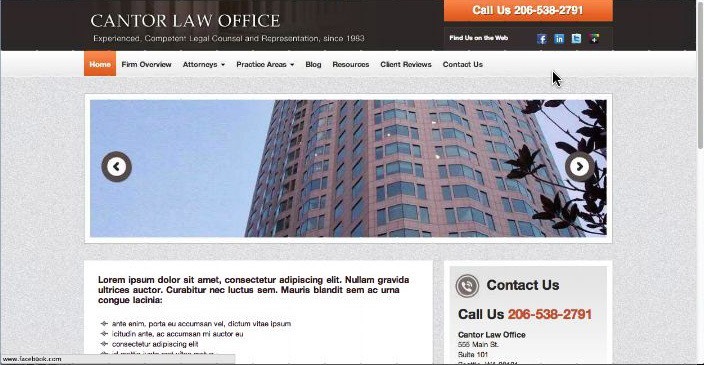
A website template from Avvo Ignite Starter.
The primary function is to track contacts with a firm by potential clients and provide intelligence on marketing effectiveness. The dashboard follows how a contact comes to the firm (e.g., by website form, Facebook, Google ad, etc.) and what happens with the contact thereafter. It also helps manage the firm’s relationship with the contact, letting the firm, for example, create automated thank you emails to be sent after an initial phone call or set reminders for following-up with a contact.
The services creates a database of all contacts, showing how they came to the firm, the nature of their case, their status as a prospect or client, and the attorney responsible for the contact, if any.
The service has numerous tools for tracking contacts. It will track all the firm’s email communications with the contact. (This is done securely — no content is visible to anyone at Avvo.) It will also track all the contact’s activity on the firm’s website. If a contact returns to the firm’s site six months after the last contact, the firm will be notified.
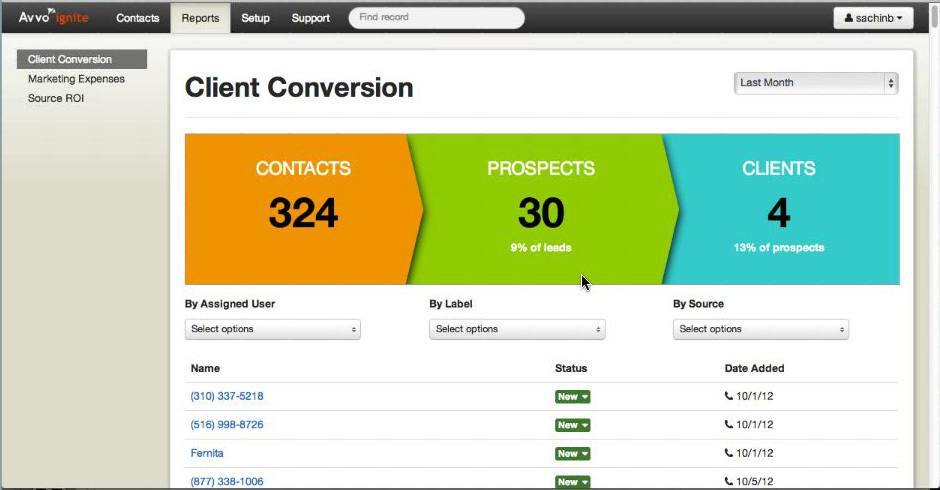
Avvo Ignite Suite provides a graphical client-conversion report.
The source ROI report lets you evaluate the effectiveness of your marketing expenditures. It uses graphs to chart how much you are spending and what return you are getting for that expense in new clients.
Avvo Ignite Suite is designed to work on mobile devices, so a lawyer can track contacts whenever necessary and receive real-time alerts of client contacts and reminders.
All of the information in Ignite Suite can be exported to be used in Outlook or a customer relationship management system.
Pricing
To purchase the website service, Avvo Ignite Starter, the cost is $199 a month, plus a $499 one-time set-up fee. The set-up fee is waived for anyone who pays for a full year in advance. The price includes the site set-up and customization (including licensing of stock photos), hosting and updates. Also, Avvo submits the site to local and national directories.
To purchase the dashboard service, Avvo Ignite Suite, the cost varies depending on the number of marketing “channels” to be monitored. (A channel would be Facebook, a blog, YouTube, LinkedIn, or the like.) For up to five channels, the cost is $199 a month. For up to 10 channels, it is $299 a month. For up to 14 channels, it is $399 a month. There is also a $499 set-up fee, which includes set-up of the system, training on the system, installation of tracking codes, and other components.
Subscribers to either service also receive access to Avvo University, a collection of webinars, guides and training videos about online marketing and business development.
The Bottom Line
For any law firm that is serious about online marketing, it should be using some sort of analytics tool to track the success of its efforts. Otherwise, the firm may well be throwing good money after bad. Many lawyers use Google Analytics, a free but highly sophisticated tool for tracking online marketing. The problem with Google Analytics — if you want to call it a problem — is that it provides too much information. Mastering it takes time — and few attorneys have that kind of time.
By contrast, Avvo Ignite Suite makes its analytics more easily digestible. In my interview with Sachin Bhatia, he could not repeat often enough that the emphasis with these services is on “hassle free.” Plus, Avvo says it will provide training and coaching in use and set-up of the system.
As with so many products and services, the final answer as to whether this is right for your firm will depend on a cost-benefit analysis. If your firm is presently spending a fair amount of money on online marketing, then this service could well be a smart investment. For that matter, even if you are just spending a lot of time on online marketing, it could be a good investment, since time is money. Either way, the question you need to answer is whether this service coul
Friday, August 23, 2013
Marketing Litigators
One involves a short story: when I was an in-house marketer, one of the top lawyers in the litigation department – other lawyers would agree he is a trial lawyer’s trial lawyer. He loved to try cases, and didn’t use scorch earth tactics. Just a really nice guy who was good at what he did. He came to me in January one year and said two of the cases he had set for trial that month were settled at the insistence of the client. He then asked me what he should do. I said to him “you know what you have to do…” and he finished the sentence “… make a trip to California, I know.” He represented a number of Japanese companies handling products liability cases. So, out he went for a few days of schmoozing a number of clients, and returned with four new cases. Lesson learned: visit your clients off the clock and, more often than not, you will gain immediate new work.
Okay, okay, I know that all litigators do not have the luxury of clients confronted with a steady stream of lawsuits, and may only handle one case for a client. But there is still value in visiting that client to see how things are going, and with “staying top of mind” a worthwhile goal. The client, because of their own lawsuit, may be particular attuned to hearing about others they could refer.
Other business development actions that can help include:
- Being active in organizations where your types of clients hang out. This would include speaking, writing and networking opportunities of course; but may also, by being really active as a volunteer or holding a position of influence within the organization, offer opportunities for a greater profile than your competitors; and
- Being an available legal source for reporters on the local and national stage. Take a reporter to lunch is a good way to start a relationship that can produce results in time.
Friday, July 12, 2013

Monday, April 1, 2013
How National News Can Become Marketing Gold!
So last week as the gay marriage debate was raging in the Supreme Court I thought about how my clients could benefit by bringing the issue home for a local perspective on the issue. Luckily, my contacts at Fox news here in Houston have a morning show that involves a lot of live talk time. I was able to get one of my clients, Cindy Diggs, a Board Certified Family Law Attorney on to talk live about the issue and how the impending SCOTUS decision could affect the Texas family court and Texan same-sex couples.
The resulting coverage ( four hits of about 3- 5 minutes each) not only made for great content for her social media pages, but we are starting a website page for her devoted solely to same sex issues and optimizing it with her four news clips! Always be on the lookout for national news you can offer a local opinion on.
See one of her clips here:
The resulting coverage ( four hits of about 3- 5 minutes each) not only made for great content for her social media pages, but we are starting a website page for her devoted solely to same sex issues and optimizing it with her four news clips! Always be on the lookout for national news you can offer a local opinion on.
See one of her clips here:
Wednesday, November 7, 2012
Why Lawyers Should Love Inbound Marketing
Just when most lawyers got used to traditional marketing – print ads,
Yellow Pages listings, billboards, radio and TV ads – along comes a
discipline called inbound marketing that turned everything you thought
you knew about law firm marketing on its head.
Inbound marketing pulls people in who are interested in what you have to offer. It consists of social media marketing, SEO, blogging, e-newsletters, videos, free report offers on landing pages, email marketing and other strategies that attract consumers naturally.
Inbound marketing allows you to nurture relationships with potential leads all the way along the various stages of the buying cycle. You can automate your messaging early in the cycle for the shoppers, then spend your resources more carefully on interacting with those who are in the later stage of ready-to-buy.
This infographic from The Whole Brain Group, a Michigan-based inbound marketing agency, explains it simply and succinctly:

Inbound marketing pulls people in who are interested in what you have to offer. It consists of social media marketing, SEO, blogging, e-newsletters, videos, free report offers on landing pages, email marketing and other strategies that attract consumers naturally.
Inbound marketing allows you to nurture relationships with potential leads all the way along the various stages of the buying cycle. You can automate your messaging early in the cycle for the shoppers, then spend your resources more carefully on interacting with those who are in the later stage of ready-to-buy.
This infographic from The Whole Brain Group, a Michigan-based inbound marketing agency, explains it simply and succinctly:

Monday, April 9, 2012
Consider an Internal Coaching Program to Get Marketing Results
Great post today from Legal Marketing blog.com's Tom Kane:
At a presentation to lawyers and marketing people this week at the LMA Triad City Group, I was talking about best practices. I didn’t just suggest tips for those activities that work best IMHO, or planning action items around them, but pointing out that in my experience the biggest obstacle to lawyer business development is the implementation phase. So, I suggested that they engage a coach (or as some refer to the role as a nag).
A lawyer from the host firm approached me after my talk and mentioned that, as a member of the marketing committee, implementation was their firm's biggest problem. So, I suggested he get a coach to help. And I told him that the coach doesn't need to be an outside consultant.
The coach could be another lawyer within the firm. Ideally, someone who has been there and done that. Or the coach could be a colleague who wants to succeed as much as you do, and will agree to be your coach, and you theirs. In the case of solos, you could find another non-competing solo or a friend in a small firm to serve in that role.
The idea is to meet on a set day and time weekly, or at least bi-weekly to share ideas, and for each to report on actions completed since the last meeting. Personally, once a month is too infrequent and results in losing momentum.
On point is today's meditation from 365 Marketing Mediations: Daily Lessons for Marketing & Communications Professionals by Larry Smith and Richard Levick which consists of just four words:
"Discussions are not actions."
Indeed. Discussions about developing business, and developing action plans are not the crucial actions that count. So, get a coaching program launched in your firm to ensure your business development plans are actually implemented.
At a presentation to lawyers and marketing people this week at the LMA Triad City Group, I was talking about best practices. I didn’t just suggest tips for those activities that work best IMHO, or planning action items around them, but pointing out that in my experience the biggest obstacle to lawyer business development is the implementation phase. So, I suggested that they engage a coach (or as some refer to the role as a nag).
A lawyer from the host firm approached me after my talk and mentioned that, as a member of the marketing committee, implementation was their firm's biggest problem. So, I suggested he get a coach to help. And I told him that the coach doesn't need to be an outside consultant.
The coach could be another lawyer within the firm. Ideally, someone who has been there and done that. Or the coach could be a colleague who wants to succeed as much as you do, and will agree to be your coach, and you theirs. In the case of solos, you could find another non-competing solo or a friend in a small firm to serve in that role.
The idea is to meet on a set day and time weekly, or at least bi-weekly to share ideas, and for each to report on actions completed since the last meeting. Personally, once a month is too infrequent and results in losing momentum.
On point is today's meditation from 365 Marketing Mediations: Daily Lessons for Marketing & Communications Professionals by Larry Smith and Richard Levick which consists of just four words:
"Discussions are not actions."
Indeed. Discussions about developing business, and developing action plans are not the crucial actions that count. So, get a coaching program launched in your firm to ensure your business development plans are actually implemented.
Wednesday, March 21, 2012
How Do Website Analytics Translate into ROI?
Website analytics can tell a marketer a lot. It’s interesting to track how visitors are finding, navigating and experiencing your website, but, this information needs to be analyzed and tracked over time to really benefit the user.
Here are some tips on how to do that:
Timeframes are a great way of tracking the popularity of a website or webpage. Look at a longer time frame and account for website changes, additions and Google's indexing to determine longevity and whether a particular page is doing really well.
Monitor firm, practice group and individual blog analytics for visitor metrics while considering the quantity and quality of posted comments. Determine what type of content generates a high level of interest. Analyze trends in two-way communication. For example, what type of content leads to discussions between blog followers? Adapt and modify the firm’s blog posts to encourage stronger follower participation.
More Friday!
Here are some tips on how to do that:
Timeframes are a great way of tracking the popularity of a website or webpage. Look at a longer time frame and account for website changes, additions and Google's indexing to determine longevity and whether a particular page is doing really well.
Monitor firm, practice group and individual blog analytics for visitor metrics while considering the quantity and quality of posted comments. Determine what type of content generates a high level of interest. Analyze trends in two-way communication. For example, what type of content leads to discussions between blog followers? Adapt and modify the firm’s blog posts to encourage stronger follower participation.
More Friday!
Friday, March 16, 2012
One in Five Law Firm Marketing Emails Opened
Larry Bodine Law Marketing Blog
According to a new study of 8 million marketing emails sent by 25 law firms over a two-year period, the average "open rate" for a marketing email is 20%. Two factors are pushing down the open rate: information overload and image blocking, according to The State of Law Firm Email Marketing published by eLawMarketing of New York.
eLawMarketing is a leading provider of online marketing services to the legal profession. Since 2002, the company has worked with more 100 law firms and individual attorneys to carry out online marketing strategies. eLawMarketing’s existing law firm clients distribute more than 4.8 million emails a year to clients, referral sources, and other business contacts.
"The open rate is driven by whether subscribers recognize the name of the individual or company in the “From” line, and find your subject line compelling and interesting," said Joshua E. Fruchter, Esq., author of the report.
Other highlights:
The average conversion rate (the percentage of subscribers who click links in law firm emails to read more) is 15.6%. Recipients won’t click a link to “read more” (or to “register”) unless they are seriously interested in learning more about the topic discussed.
The average bounce rate (an undeliverable email) is 2.6%.
The average unsubscribe rate is 0.17%.
The conversion rate can be increased by providing a web version of the email, putting calls-to-action in text (instead of graphics), avoid using a large banner graphic that gets in the way of text and designing your email no wider than 650 pixels. Learn more about email design best practices at http://bit.ly/cjutRZ.
"The bounce rate is typically a good proxy for list hygiene, that is, how “clean” your list is. If your bounce rates are significantly higher than the legal industry norms, then your lists may be stale. To avoid harming the reputation of your domain, reconsider how you are assembling your distribution lists to make sure you are using only recently updated lists of clients and other contacts," Fruchter said.
People unsubscribe from emails because they may already get emails on the same topic from a different source. "Or perhaps their inbox is overloaded and they are pruning the number of emails they receive. In a worst case scenario, a subscriber may unsubscribe because they don’t recognize who you are, and are annoyed to have received email from you in the first place," he said.
Tags: Marketing
According to a new study of 8 million marketing emails sent by 25 law firms over a two-year period, the average "open rate" for a marketing email is 20%. Two factors are pushing down the open rate: information overload and image blocking, according to The State of Law Firm Email Marketing published by eLawMarketing of New York.
eLawMarketing is a leading provider of online marketing services to the legal profession. Since 2002, the company has worked with more 100 law firms and individual attorneys to carry out online marketing strategies. eLawMarketing’s existing law firm clients distribute more than 4.8 million emails a year to clients, referral sources, and other business contacts.
"The open rate is driven by whether subscribers recognize the name of the individual or company in the “From” line, and find your subject line compelling and interesting," said Joshua E. Fruchter, Esq., author of the report.
Other highlights:
The average conversion rate (the percentage of subscribers who click links in law firm emails to read more) is 15.6%. Recipients won’t click a link to “read more” (or to “register”) unless they are seriously interested in learning more about the topic discussed.
The average bounce rate (an undeliverable email) is 2.6%.
The average unsubscribe rate is 0.17%.
The conversion rate can be increased by providing a web version of the email, putting calls-to-action in text (instead of graphics), avoid using a large banner graphic that gets in the way of text and designing your email no wider than 650 pixels. Learn more about email design best practices at http://bit.ly/cjutRZ.
"The bounce rate is typically a good proxy for list hygiene, that is, how “clean” your list is. If your bounce rates are significantly higher than the legal industry norms, then your lists may be stale. To avoid harming the reputation of your domain, reconsider how you are assembling your distribution lists to make sure you are using only recently updated lists of clients and other contacts," Fruchter said.
People unsubscribe from emails because they may already get emails on the same topic from a different source. "Or perhaps their inbox is overloaded and they are pruning the number of emails they receive. In a worst case scenario, a subscriber may unsubscribe because they don’t recognize who you are, and are annoyed to have received email from you in the first place," he said.
Tags: Marketing
Monday, February 13, 2012
Legal Spending Metrics: Get on the Bus
Recently, my cousin described her approach to dealing with a family crisis: Chase the bus, get on the bus or drive the bus. Being an action-oriented person, her preference was to learn everything she could about the issue, gather expert advice, and then make decisions and address the situation head-on. In other words, she chose to drive the bus.
General counsel, chief legal officers and other law department leaders confront similar choices, as the legal profession is in the midst of an industrial revolution in legal services.
The Merriam-Webster online dictionary defines an industrial revolution as "a rapid major change in an economy (as in England in the late 18th century) marked by the general introduction of power-driven machinery or by an important change in the prevailing types and methods of use of such machines."
Other commentators point to a confluence of socioeconomic changes characterized by a mechanization of manufacturing — moving away from hand-crafted and guild-oriented practices — and new power sources. At the same time, new sources of capital, increased global trading opportunities, and more knowledgeable and demanding consumers play a key role in creating structural changes and upheaval in economies and societies that undergo their own versions of England's experience in the 1800s. (Gavin Weightman's recent book "The Industrial Revolutionaries: The Making of the Modern World 1776-1914" covers these topics in a very readable fashion.)
Doesn't this sound a lot like events in the legal services industry? Consider these examples:
• the rise of the types of automated tools that an Oct. 11, 2011, article in The Wall Street Journal dubbed "robo-lawyers";
• lower-cost lawyers in lower-cost locations or — in what will likely be the next phase of outsourcing — nontraditional legal-services suppliers that are high quality, technologically innovative, and able to scale up or down as needed;
• the United Kingdom's legislation permitting the injection of outside investment capital into firms; and
• the host of metrics and process-oriented acronyms featured in the legal trade press, including legal process outsourcing (LPO), legal project management (LPM), knowledge management (KM), key performance indicators (KPIs) and so forth.
Of course, lawyers and firms are, in general, not at the leading edge of any adoption curve (technology or otherwise). They are more likely to be chasing the bus. In a piece for Law360, Dave Dolkas wrote about a firm sending lawyers to Six Sigma training, which is a technique for increasing quality and decreasing costs popularized several decades ago. He argued that the attention the firm received for using this long-established approach shows just how far behind lawyers are in adopting quality improvement and cost-control measures.
Despite this, a GC or CLO might be wary of moving away from a traditional legal services sourcing strategy — business speak for "hiring the firms we've always used." But as boards of directors and executives demand more value from the legal department — without necessarily having much of a concept of how to measure the value of legal services — the risk of doing little or nothing far exceeds the risk of implementing a plan to measure and increase the value of every dollar the company spends on lawyers.
In other words, it's time to get on the bus. No GC wants the board to measure success in managing legal costs solely on a procurement-oriented model, which typically asks, "How much less did we spend this year than last year?" But failing to implement at least a few simple but meaningful metrics can lead to that outcome.
Driving the Bus
So, how can in-house counsel get in the driver's seat? It's time to draft a new set of operating principles. Counsel should consider these five steps as one possible template for taking action.
1. Define five key performance indicators for each major outside firm . These should be easily measurable. The GC should review the results each quarter and then spend 30 minutes with each firm, reviewing their improvement opportunities.
2. Identify where project management responsibility lies for significant M&A, litigation and other projects. Does the in-house or outside lawyer or other professional responsible for project management have the training and tools necessary to bring the project in on-time, on-budget and on-targeted outcome?
Measuring the effectiveness of project management requires first defining what constitutes a successful project. Clear standards are necessary for improved performance.
If the requisite training and tools are not in place, consider hiring specialized project managers to guide major projects.
3. Adopt a process orientation . Process mapping can identify chronic problems: work that needs to be re-done, inefficiencies, and inappropriate staffing, such as having senior lawyers do work that could be automated or completed by lower-paid associates or paralegals. These routine tasks probably aren't going away, but they often can be resourced and completed more efficiently.
4 . Document, evaluate and continuously improve the sourcing strategy or outside legal services. Using a portfolio approach — segmenting legal needs into substantive areas, with an assessment of risk and value, and then sourcing legal services for each segment accordingly — can help demonstrate how legal spending aligns with the company's opportunities to get more for less and mitigate risks.
Use technology to measure the costs and outcomes against the strategy's success criteria. Show the board of directors and C-suite colleagues metrics that align with the reports they already receive from other parts of the company. One example would be to show the total cost of ownership (TCO) of key types of legal projects.
5. Make collaboration a key word among the team, and put it into action every day. Use technology to improve oversight of major matters and to interact more effectively with outside counsel (and I don't mean "send more emails," by the way).
Institutionalize a protocol for every matter sent to outside counsel: The responsible in-house lawyer must engage in a dialogue with the lead outside lawyer to create clear, yet flexible, metrics by which to measure value and success. Some outside firms may resist. But staying clear and firm about the company's requirements will result in the best firms accepting that the legal department is serious about defining value.
It's time to get started — jump on the bus, take the wheel and drive on down the road.
Jim Boeckman, president of Right-Tasking Consulting, helps general counsel get the best legal services for their money. He consults with in-house leaders on projects that optimize the sourcing, cost and management of their legal resources. For more than 20 years, he practiced at major firms in Austin and Dallas and as in-house counsel at high-tech companies in Austin, Dallas and Australia. His blog, Boosting Legal Value, is at www.Right-Tasking.com/blog.
General counsel, chief legal officers and other law department leaders confront similar choices, as the legal profession is in the midst of an industrial revolution in legal services.
The Merriam-Webster online dictionary defines an industrial revolution as "a rapid major change in an economy (as in England in the late 18th century) marked by the general introduction of power-driven machinery or by an important change in the prevailing types and methods of use of such machines."
Other commentators point to a confluence of socioeconomic changes characterized by a mechanization of manufacturing — moving away from hand-crafted and guild-oriented practices — and new power sources. At the same time, new sources of capital, increased global trading opportunities, and more knowledgeable and demanding consumers play a key role in creating structural changes and upheaval in economies and societies that undergo their own versions of England's experience in the 1800s. (Gavin Weightman's recent book "The Industrial Revolutionaries: The Making of the Modern World 1776-1914" covers these topics in a very readable fashion.)
Doesn't this sound a lot like events in the legal services industry? Consider these examples:
• the rise of the types of automated tools that an Oct. 11, 2011, article in The Wall Street Journal dubbed "robo-lawyers";
• lower-cost lawyers in lower-cost locations or — in what will likely be the next phase of outsourcing — nontraditional legal-services suppliers that are high quality, technologically innovative, and able to scale up or down as needed;
• the United Kingdom's legislation permitting the injection of outside investment capital into firms; and
• the host of metrics and process-oriented acronyms featured in the legal trade press, including legal process outsourcing (LPO), legal project management (LPM), knowledge management (KM), key performance indicators (KPIs) and so forth.
Of course, lawyers and firms are, in general, not at the leading edge of any adoption curve (technology or otherwise). They are more likely to be chasing the bus. In a piece for Law360, Dave Dolkas wrote about a firm sending lawyers to Six Sigma training, which is a technique for increasing quality and decreasing costs popularized several decades ago. He argued that the attention the firm received for using this long-established approach shows just how far behind lawyers are in adopting quality improvement and cost-control measures.
Despite this, a GC or CLO might be wary of moving away from a traditional legal services sourcing strategy — business speak for "hiring the firms we've always used." But as boards of directors and executives demand more value from the legal department — without necessarily having much of a concept of how to measure the value of legal services — the risk of doing little or nothing far exceeds the risk of implementing a plan to measure and increase the value of every dollar the company spends on lawyers.
In other words, it's time to get on the bus. No GC wants the board to measure success in managing legal costs solely on a procurement-oriented model, which typically asks, "How much less did we spend this year than last year?" But failing to implement at least a few simple but meaningful metrics can lead to that outcome.
Driving the Bus
So, how can in-house counsel get in the driver's seat? It's time to draft a new set of operating principles. Counsel should consider these five steps as one possible template for taking action.
1. Define five key performance indicators for each major outside firm . These should be easily measurable. The GC should review the results each quarter and then spend 30 minutes with each firm, reviewing their improvement opportunities.
2. Identify where project management responsibility lies for significant M&A, litigation and other projects. Does the in-house or outside lawyer or other professional responsible for project management have the training and tools necessary to bring the project in on-time, on-budget and on-targeted outcome?
Measuring the effectiveness of project management requires first defining what constitutes a successful project. Clear standards are necessary for improved performance.
If the requisite training and tools are not in place, consider hiring specialized project managers to guide major projects.
3. Adopt a process orientation . Process mapping can identify chronic problems: work that needs to be re-done, inefficiencies, and inappropriate staffing, such as having senior lawyers do work that could be automated or completed by lower-paid associates or paralegals. These routine tasks probably aren't going away, but they often can be resourced and completed more efficiently.
4 . Document, evaluate and continuously improve the sourcing strategy or outside legal services. Using a portfolio approach — segmenting legal needs into substantive areas, with an assessment of risk and value, and then sourcing legal services for each segment accordingly — can help demonstrate how legal spending aligns with the company's opportunities to get more for less and mitigate risks.
Use technology to measure the costs and outcomes against the strategy's success criteria. Show the board of directors and C-suite colleagues metrics that align with the reports they already receive from other parts of the company. One example would be to show the total cost of ownership (TCO) of key types of legal projects.
5. Make collaboration a key word among the team, and put it into action every day. Use technology to improve oversight of major matters and to interact more effectively with outside counsel (and I don't mean "send more emails," by the way).
Institutionalize a protocol for every matter sent to outside counsel: The responsible in-house lawyer must engage in a dialogue with the lead outside lawyer to create clear, yet flexible, metrics by which to measure value and success. Some outside firms may resist. But staying clear and firm about the company's requirements will result in the best firms accepting that the legal department is serious about defining value.
It's time to get started — jump on the bus, take the wheel and drive on down the road.
Jim Boeckman, president of Right-Tasking Consulting, helps general counsel get the best legal services for their money. He consults with in-house leaders on projects that optimize the sourcing, cost and management of their legal resources. For more than 20 years, he practiced at major firms in Austin and Dallas and as in-house counsel at high-tech companies in Austin, Dallas and Australia. His blog, Boosting Legal Value, is at www.Right-Tasking.com/blog.
Subscribe to:
Posts (Atom)